Why a Quieter Home Teaches Louder Lessons Than We Realize
By Rita Wilkins, The Downsizing Designer™
The Lessons We Don’t Mean to Teach
Children are always learning… not only from what we say, but from what surrounds them.
The home is their first classroom.
Long before children understand rules, routines, or responsibility, they absorb cues from their environment. An uncluttered home is not about perfection. It is about clarity, calm, and intention. Those qualities quietly shape how children think, feel, and move through the world.
For parents and grandparents alike, the state of a home sends daily messages:
- What matters
- How we care for our belongings
- How we care for ourselves and others
- How we handle overwhelm
Less clutter does not mean less love. Often, it means more presence.
Organization Teaches That Everything Has a Place
When a home has fewer, well-chosen toys and belongings—and when those items are intentionally organized—children learn something foundational: things belong somewhere.
This simple understanding supports early decision-making skills. Children learn how to choose what to play with, how to transition between activities, and how to return items when they are finished.
Organization creates predictability. Predictability builds safety. And safety allows children to relax, explore, and grow with confidence.
Responsibility Starts Small
Having a place for everything makes cleanup possible. Cleanup teaches responsibility quietly—without lectures or raised voices.
When children are invited to put things away, they practice follow-through and accountability in age-appropriate ways.
For grandparents, this is where modeling matters deeply. Children do not learn responsibility from being told. They learn it by watching adults care for their spaces and respect the spaces of others.
Chores as Contribution, Not Punishment
Chores often get a bad reputation, yet they are one of the most powerful teaching tools in a home.
When children participate in simple household tasks, they learn that they are needed, that they matter, and that their contribution counts.
Helping set the table, folding towels, or putting toys away builds cooperation, pride, and shared responsibility. It quietly says: You belong here. You are part of this family.
Focus Thrives in Simpler Spaces
Clutter competes for attention. When too many toys and distractions fill a room, a child’s ability to focus is quietly challenged.
An uncluttered home allows children to stay with an activity longer, think more deeply, and engage more fully—without feeling overwhelmed.
Fewer choices often create greater freedom. Focus supports patience, persistence, and emotional regulation over time.
Creativity Grows When Space Is Open
Creativity does not come from having more. It comes from having room.
When children are not overstimulated by excess, they invent, imagine, and explore more freely. Open space invites storytelling, building, drawing, and problem-solving.
Creativity flourishes when the environment leaves room for curiosity and childlike wonder.
Productivity Without Pressure
Children in uncluttered homes often develop natural productivity—not because they are pushed, but because their environment supports them.
Clear surfaces and organized storage help children move smoothly from one activity to another. The home becomes a place that supports flow rather than frustration.
Emotional Regulation Begins at Home
Clutter can create low-level stress, even for children who cannot yet name it. Busy environments often lead to irritability, fatigue, and emotional overload.
Uncluttered homes tend to feel calmer, more grounded, and more predictable. Children raised in calmer spaces often learn to self-soothe more easily and feel safer expressing their emotions.
A Healthy Sense of Self Beyond Stuff
When children are not defined by what they own, they begin to understand who they are beyond possessions.
They learn that their worth is rooted in relationships, imagination, and experience—not in having more, newer, or better things. This supports a healthier sense of identity that lasts well beyond childhood.
Why Modeling Matters More Than Rules
Children are always watching. How adults treat their belongings, manage their homes, and respond to mess sends powerful signals.
Grandparents, in particular, carry enormous influence. A calm, intentional home shows children that life does not need to feel rushed or overwhelming to be meaningful.
A Real-Life Example of Quiet Modeling
I recently purchased an eight-compartment Montessori shelf from Wayfair to store some of my granddaughter’s toys. I have shopped with them before, and it has been ideal for intentional storage like this.
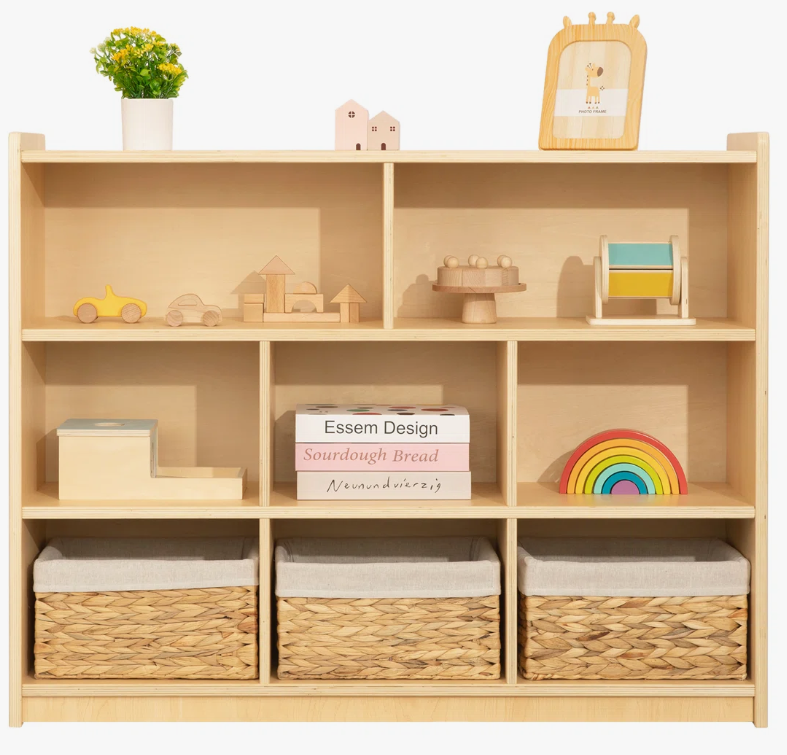
One afternoon, I watched her carefully return a toy to its basket before choosing another. No one asked her to do this. She was simply mirroring what she sees every day—at home, at school, and in my home.
That is the quiet power of modeling.
What Grandparents Pass Down
For Baby Boomers, this conversation is deeply personal. The homes we create for our grandchildren become memory-makers—places of safety, values, and connection.
An uncluttered home offers grandchildren space to breathe, connect, and feel at ease. It quietly reinforces lessons they will one day carry into their own homes.
The Bottom Line
Children do not need more stuff. They need space—to think, to play, to rest, and to belong.
An uncluttered home does more than look calm. It teaches calm.
It does more than feel organized. It teaches responsibility and care.
Over time, it shapes how children see themselves and the world around them.
Feeling overwhelmed by toys or clutter in your home?
Learn how to let go with clarity and confidence in my newest Letting Go Workbook, and receive a free Companion Guide with your purchase.
SHARE YOUR STORY!
Sign up for Rita’s FREE Newsletter HERE!
Never miss an episode! Click the following link to like Rita’s Facebook page or subscribe to her Decluttering YouTube Channel. Check out our YouTube playlists if you want to learn more.